Wednesday, 16 June 2010

Cooking, Wine and Olives in Amiata

Our wonderful and flamboyant host and chef, Enrico, treated us to a cooking class at his olive farm, where of course, the farm produced olive oil was used with gusto in our creations.

P1030469sm From learning that the basis of Italian cooking is onion and celery, to brewing a delicious and hearty mushroom and beans soup, to handmade pasta and of course authentic pizza base, we thoroughly enjoyed our creations at lunch and enjoyed even more seeing our soup and pasta being served to guests in the restaurant.

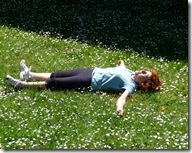
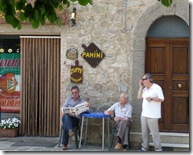
P1030423sm The afternoon was spent lazing about the poolside or walking to the next gorgeous village. Dinner was a special occasion as well with live music ad plenty of wine and dancing. The Australian girls do know how to have fun.

P1030424smIn the morning we walked about 6 kms to the modern art park of  Daniel Spoerri, whose sculpture garden is a special mix of art and nature, where time alone amongst the sculptures allowed me to feel some of what the artist portrayed.

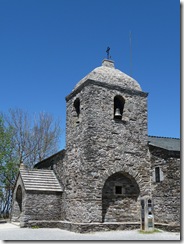
The next day we enjoyed a morning walk from the breathtakingly beautiful and simple San Antimo Abbey, which dates back to the 8th century.

P1030383sm  P1030370sm

P1030438sm We then met some busy locals in the village, ate some wild cherries straight from the tree and walked through stunning countryside for about 1.5 hours to arrive at an organic winery where Katia and her son Daniel treated us to a P1030427sm wonderful lunch under the old oak tree, while overlooking the valley below. The afternoon was like being invited to lunch at a friends place. This small winery produces DOCG wine in the organic way. It was a very special afternoon, and our walk continued after lunch to arrive at another beautiful family run wine farm where we are enjoying 3 nights in comfort, surrounded by the sights and sounds of nature as well as more walks through this beautiful Tuscan land. Ahh, it feels like heaven!

P1030473sm

- signing off from Marika, Women's Own Adventure

Friday, 11 June 2010

Wild Roses in the Tuscan Countryside

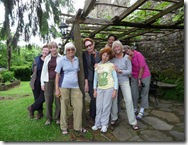
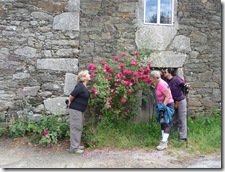
Beautiful wild roses grow along the side of country trails while the other wild roses from Women's Own Adventure walk along these same winding trails.


We are now staying in a beautiful olive farm with a pool and a view to die for. The hills of Tuscany are simply beautiful. Today we walked for about 4 hours through little country roads and picked wild cherries along the way, wild strawberries, through chestnut forests, saw almond and walnut trees and of course lots of olive trees and grapevines as well as so many different coloured and scented wild roses. We also met an Australian man who moved here with his wife and live in a beautiful house that was rundown and empty for 30 years, they were here on holidays about 8 years ago and decided to stay and bought the old house and fixed it up.


Lunch was served in a 10th century castle which is now owned by an English family and has been restored from almost ruins over the past 10 years. They grow grapevines and olive trees, making their own wine as well as their own olive oil. Both are fantastic! The local wine, especially the red wine is very good and is served with every meal (except breakfast thankfully).

The other morning, while some of us enjoyed a hilltop walk of some 8 kms to be rewarded with beautiful 360° views all around, two of our group took the opportunity for a 40km bicycle ride through winding roads to arrive at the natural hot springs, which are like a hot bath with waterfalls, out in the open and surrounded by trees and the sounds of birds. The Tuscan countryside is so very beautiful and very special. Their are no tourists here, so we are experiencing authentic Tuscan culture with wonderful people. This countryside is like walking through a picture postcard.
Tomorrow morning we will be having a cooking lesson at the olive farm and everyone is looking forward to that, as we will be eating our creations for lunch. Yum!
- signing off from Marika, Women's Own Adventure

Tuesday, 8 June 2010

Santa Fiori - song, dance and laughter

The first day of our journey through Southern Tuscany saw us leave the hustle and bustle of Rome behind. As it is Saturday we are doing what every local Roman does, leave the city to the tourists over the weekend. We travelled for about an hour and a half before stopping for lunch in a beautiful lakeside town. The lake is actually the crater of an ancient volcano with the water a bright blue colour against the dark sandy shore.

Another hour further on brings us to Santa Fiori, a Medieval town which has a long history, more recently that of a mineral mining town , but now houses only approximately 1,000 residents. It has a charming atmosphere with a town square of course and being built high on the hillside it has a stunning view over the valley and adjoining hills.
The highlight of our day, and a wonderful start to our trip was the evening meal and entertainment. OK we were actually the entertainment, or at least a part of it. As the evening turned out, we were guests at a party in our hotel with brilliant live music. The Australians (that is us) were seated at one end of the room and the Italians at the other end of the room. Neither of us could speak any of the other's language, however as we all know, music and dance is an international language. We were of course the rowdy lot in the room and it didn't take long for Marion to get the old Italian gentleman up and dancing, which was the incentive needed for everyone else on the Italian side of the room to join the rowdy Aussies on the dance floor. What a great night we had! The musicians played on in their own time for hours and did not want to stop with such an appreciative audience. Exhaustion finally saw us all tumble up to bed. A great start to our Tuscan experience.

- signing off, from Marika, Women's Own Adventure

Friday, 4 June 2010

Roma, a city steeped in history

Having the opportunity to spend 5 days in Rome has given me a massive lesson in history.

P1030057smThe entire first day was spent in the  Colosseum and the Roman Forum with my eyes as wide as saucers. With a history dating back over 2,700 years and watching people sit on ancient relics and walk over cobbled streets that were built so long ago has been a remarkable experience for someone who lives in a country which is a mere 200 odd years young. Fallen marble columns and other relics adorn the streets of ancient Rome, and it is an eery feeling indeed as I walked with my head looking up at the massive structures, some of which took hundreds of years to build. It was all built on such a grand scale than we mere  mortals must have felt then, as I feel now...quite insignificant in the scheme of things.

Rome is a bustling city which does take some getting used to. It is filled with tourists from all over the world as can be heard from the many different languages spoken around me. Every monument and museum is filled with people. The Vatican sees 30,000 visitors through its doors each and every day!

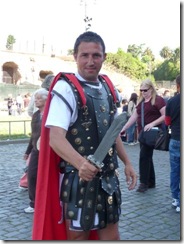
P1030059sm In having said that however,  given the choice, I would not miss the opportunity to visit Rome again. The Italian men are also quite dashing (as you can see by the photo). Listening to the beautiful Italian language with its colourful intonation has me trying to mimic the sound at every opportunity. Thankfully, most people are pleased to hear me trying to communicate with them in their own language and style, and equally thankfully, most know a little English and the hand gestures do the rest.

Tomorrow our group of Women's Own Adventure ladies will be arriving and beginning our Cultural Taste of Southern Tuscany, out of the city, which will be a welcome change of pace for me.  I will keep you updated on our journey through Tuscany over the next 2 weeks.

- signing off from Marika, Women's Own Adventure

Monday, 31 May 2010

Arriving into Santiago de Compostella

house3 We enjoyed a beautiful evening in another  Galician Manor House on the last evening on the Camino where a beautiful meal was enjoyed by everyone and served by our wonderful hosts. The Manor House is surrounded by lush gardens and fruit trees. The region near Santiago is very green and of course it receives rain much of the year. The Galician region has been influenced by the Celtic culture in their music, dress and traditions as well as the weather. We were however very fortunate and only experienced a slight drizzle on one of the days.

 P1030030 P1020997

The last day of our journey we walked 23 kms though beautiful oak forests, along rocky paths and through gum tree forests as well, finally arriving on weary legs to the Monte del Gozo “Mount of Joy”, we could see the city of Santiago de Compostella and the Cathedral below. Another 5 kms to walk.

We arrived into Santiago in the afternoon of 27th May 2010.  It was a joyous moment, even though we hid it well behind our weariness. But we all made it!

P1030020

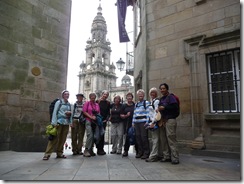
P1030038Those who wanted to, received their Compostella (Certificate) for  having walked the last 100kms to Santiago. The streets of the city are full of life and people from so many different countries. The old town is a pleasure to wander through, discovering the many small shops, bars and restaurants. On the last evening together we were even treated to some local music, with Paty and Jane showing off their dance steps.

Friendships have been formed and our journey has come to an end as we look forward to sharing stories and photos with loved ones and staying in touch with each other.

I am meeting my next group in Rome next week, for our Journey through Southern Tuscany. You can read about here.

- signing off from Marika, Women's Own Adventure

Thursday, 27 May 2010

Important Lessons along the Camino de Santiago in Spain

Thousands of Pilgrims have travelled the path of Saint James all through the centuries, the same path that we have walked.  Each Pilgrim completes their own journey with lessons they have learned along the way.

Here are some of the lessons the group from Women's Own Adventure have learned.

Lesson 1 - available men are in abundance

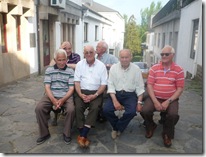
men1 men2

Lesson 2 - how to stop and smell the roses

rest1 rest2

smell roses

Lesson 3 - improved fashion sense

fashion2 fashion1

 pilgrim2 fashion3

Lesson 4 - Social Graces

* the art of napkin folding into unmentionable things (the photo has been censored)

* how to mix our drinks, vino tinto, vino blanco, tinto de verano (red wine, white wine, red wine with soda) at every meal and between meals.

Lesson 5 - Local Customs and Cuisine

* yes, there is a Jamon Museum

jamon museum

* fine dining table service sometimes means 3 courses served in 10 minutes and/or when the waitress stands there not saying anything with a gruff face it means 'may I take your order please?'

* sometimes fruit for desert means a whole apple  or a whole orange on a plate

* listening to flamenco guitar and singing right outside our bedroom window at 11.30pm after walking for the better part of 20kms.

Lesson 6 - A Man's Home is his Palace

There are many bargains to be had when seeking shelter along the Camino.

house1

It is a wise Pilgrim who once said  'No Pain - No Glory' as we nurse our sore and bandaged feet while hobbling along with legs that just don't want to co-operate with the body anymore.

Buen Camino! and it is!

- signing off from Marika, Women's Own Adventure

Saturday, 22 May 2010

Walking through pre-Roman and Medieval Villages

It has been a few days since the last entry, as time and a lack of internet access prevented me from updating this blog.

P1020732 P1020770

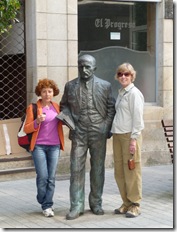
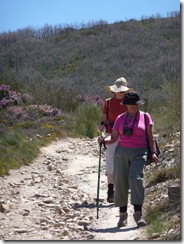
Our group of women adventurers are now actively trekking along the Camino de Santiago (The Spanish Pilgrims Trail).  Castrillo de los Polvazares was our starting point for day 3. This is a small Medieval stone village that has been declared a National Monument. Though every village we have walked through is actually a walk through history from as far back as pre-Roman times.  Some villages have restored buildings and others have P1020762 been left abandoned and with few people.  We walked to Rabanal and stayed in an Albergue overnight where we shared the accommodation with pilgrims from all over the world. Everyone was happy to rest weary legs and attend to blistered feet. That evening we attended the village church and were treated to beautiful singing by the priests as well as a message delivered in many languages for all the pilgrims to hear. The pilgrims are many, with some on bicycle and others walking, though at times we don't meet anyone on the Camino for quite a few kilometers then at other times that pilgrim greeting "Buen Camino" is exchanged over and over again. Most of the pilgrims carry a shell as a symbol. In fact, the symbol of the shell marks the way.

 P1020798 P1020777

At any moment now, the Knights of the Templar should greet us on galloping horses along these Medieval trails; that is the image in my mind. On the road to Villafranca we each carry a stone which we place onto a massive conical pile of stones at the Cruz de Ferro. Adding a stone to the pile is an important ritual  and many pilgrims bring stones from home to place here.

The beautiful green countryside is  dotted with windmills and snow capped mountains as a backdrop for our days of walking.

P1020806  P1020771

This past day, walking uphill into Cebreiro we have passed by the most beautiful views, with rolling hills covered in multi-coloured wild flowers. Then to arrive at the top of the hill to this pre-Roman village boasting 360 degree views over all the valleys was simply stunning. Josefina, our local guide had a beautiful lunch of Spanish tortilla, salad and fresh bread waiting for us at the top of the hill and it was a very well deserved meal. We then enjoyed a warm bed overnight in this village. Some of the girls have also discovered Tinto Verano, a light red wine and lemon drink which helps cure the sore feet. All the meals we are experiencing are sensational.

- signing off from Marika, Women's Own Adventure.

Tuesday, 18 May 2010

Starting our walk along the Camino

Our first day along the Camino was very exciting. We began our walk from Puente de Orbigo, one of the most famous bridges along the Camino. P1020702 The weather had warmed up considerably, so we were faced with bright warm sunshine on our backs, blue skies above and a stone pathway at our feet to lead the way. The walk was only 12 kms today, for which I think everyone was quite thankful. This allowed us to ease into our boots and our walking legs. As the scenery was already so gorgeous with snow capped mountains in the distance and lush green fields along the road, our spirits were high.  Passing though villages we have learned the greeting for fellow Pilgrims along the way as the locals greeted us with 'Buen Camino".

P1020703

Astorga is the home of magnificent architecture in the form of Roman walls, a 15th Century Cathedral and Gaudi's neo-gothic Bishop's Palace. 

We are all looking forward to tomorrow where our walk will begin from a Castrillo, small medieval stone village, just outside of Astorga. This village has been declared a national monument.

- signing off from Marika, Women's Own Adventure

Saturday, 15 May 2010

Arrival into Leon, our starting point

I have traveled to Spain several times, and it never ceases to amaze me how the Spanish people know how to enjoy life. No matter which village, town or city, no matter what day of the week, the streets, bars and restaurants  are filled with people every evening. Their culture is such a wonderfully social one. The days are always long, with the sun still shining at 9:30opm (it is not summer yet), what a wonderful contrast to Sydney, where it was already dark before 6pm when I left the other day. Even though it is quite a lot cooler here, people just rug up and are out on the streets walking, talking, eating, drinking and socialising.

I arrived in the afternoon and found all the shops and services closed for the lunch period (from 2pm to 5pm), except the bars and restaurants. Everything opens again from 5pm till 9 or 9:30pm, so the days become long where a lot of activity can fit into one day. The evening meal is eaten after 9.30pm and the streets are full of activity until past midnight, including small children playing on the streets. Viva! The Spanish people know how to live life!

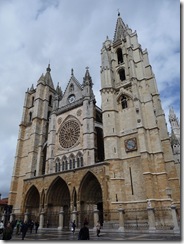
P1020650Leon is one of the most historic towns of Old Castile, with a history spanning from the 11th Century and boasting the beautiful and magnificent Basilica de San Isidoro.  This is considered to be one of the greatest Romanesque treasures along the Pilgrim's Way, and is one of the best examples of a Gothic Cathedral in Spain. Featuring vaulted ceilings, magnificent stained glass windows and flying buttresses.

We will spend some time exploring this beautiful town, once the group of Women's Own Adventure ladies all arrive in the next day or two, before setting off on the start of our Pilgrim's Walk.

- signing off from Marika - www.womensownadventure.com.au

Monday, 10 May 2010

Embarking on the Pilgrims Way in Spain

A group of intrepid women, on a journey with Women's Own Adventure will be departing for the Northern part of Spain this week and I will be accompanying them. The Pilgrim’s Way to Santiago - the Camino de Santiago as it is called in Spanish, or “Way of St. James” is a journey of the soul and spirit, that takes the traveller in the footsteps of millions of others over a millennium, who sojourned from all over Christendom to this green and misty spot in the northwest corner of Iberia to venerate the tomb of the Apostle St. James - Santiago as he is known in Spanish. The site, now known as Santiago de Compostela, came to be Christianity’s 3rd Holy City, along with Rome and Jerusalem, and Santiago became the Christians’ patron saint and inspiration in their long struggle to reconquer Spain from the Moors.

Today, the Camino - “One of the world’s 2 or 3 great journeys”, according to American writer James Michener - is undergoing a renaissance unlike anything known since the 13th century peak of the pilgrimage. Modern-day ‘pilgrims’, like their forerunners, come from all over, but nowadays those with purely religious motives are joined by lovers of adventure, art, history and legends, all with a desire to take part in an experience that is unique in the modern Western world.

Our destination is the cathedral in Santiago’s fabulously preserved medieval centre, which has been declared a UNESCO World Heritage Site in its entirety. We follow the ancient pilgrim’s way through storybook-beautiful landscapes and tiny stone-built villages where time seems to have stopped, visiting Gothic cathedrals and Romanesque chapels, and a profusion of art of all kinds created throughout the centuries in honour of St. James. Over the 1000-year history of the pilgrimage, various principal routes to Santiago evolved. These days most pilgrims follow the so-called Camino Francés or “French Way”, and this is our journey through the most picturesque parts.

Our group will commence walking from Leon on 17th May and end the journey 173kms later when we walk into Santiago de Compostela on the 27th May to collect our stamped Camino Creditionals proving to ourselves and to the world that we have completed our pilgrimage.

Our journey will be documented along the way (with photos) on this blog, so please keep coming back to read about it.
signing off - Marika Martinez , Women's Own Adventure www.womensownadventure.com.au

Tuesday, 16 March 2010

Women's Month

International Women's Day has been observed since in the early 1900's, a time of great expansion and turbulence in the industrialized world that saw booming population growth and the rise of radical ideologies.


1908
Great unrest and critical debate was occurring amongst women. Women's oppression and inequality was spurring women to become more vocal and active in campaigning for change. Then in 1908, 15,000 women marched through New York City demanding shorter hours, better pay and voting rights.

1909
In accordance with a declaration by the Socialist Party of America, the first National Woman's Day (NWD) was observed across the United States on 28 February. Women continued to celebrate NWD on the last Sunday of February until 1913.

1910
In 1910 a second International Conference of Working Women was held in Copenhagen. A woman named a Clara Zetkin (Leader of the 'Women's Office' for the Social Democratic Party in Germany) tabled the idea of an International Women's Day. She proposed that every year in every country there should be a celebration on the same day - a Women's Day - to press for their demands. The conference of over 100 women from 17 countries, representing unions, socialist parties, working women's clubs, and including the first three women elected to the Finnish parliament, greeted Zetkin's suggestion with unanimous approval and thus International Women's Day was the result.

1911
Following the decision agreed at Copenhagen in 1911, International Women's Day (IWD) was honoured the first time in Austria, Denmark, Germany and Switzerland on 19 March. More than one million women and men attended IWD rallies campaigning for women's rights to work, vote, be trained, to hold public office and end discrimination. However less than a week later on 25 March, the tragic 'Triangle Fire' in New York City took the lives of more than 140 working women, most of them Italian and Jewish immigrants. This disastrous event drew significant attention to working conditions and labour legislation in the United States that became a focus of subsequent International Women's Day events. 1911 also saw women's 'Bread and Roses' campaign.

1913-1914
On the eve of World War I campaigning for peace, Russian women observed their first International Women's Day on the last Sunday in February 1913. In 1913 following discussions, International Women's Day was transferred to 8 March and this day has remained the global date for International Wommen's Day ever since. In 1914 further women across Europe held rallies to campaign against the war and to express women's solidarity.

1917
On the last Sunday of February, Russian women began a strike for "bread and peace" in response to the death over 2 million Russian soldiers in war. Opposed by political leaders the women continued to strike until four days later the Czar was forced to abdicate and the provisional Government granted women the right to vote. The date the women's strike commenced was Sunday 23 February on the Julian calendar then in use in Russia. This day on the Gregorian calendar in use elsewhere was 8 March.

1918 - 1999
Since its birth in the socialist movement, International Women's Day has grown to become a global day of recognition and celebration across developed and developing countries alike. For decades, IWD has grown from strength to strength annually. For many years the United Nations has held an annual IWD conference to coordinate international efforts for women's rights and participation in social, political and economic processes. 1975 was designated as 'International Women's Year' by the United Nations. Women's organisations and governments around the world have also observed IWD annually on 8 March by holding large-scale events that honour women's advancement and while diligently reminding of the continued vigilance and action required to ensure that women's equality is gained and maintained in all aspects of life.

2000 and beyond
IWD is now an official holiday in China, Armenia, Russia, Azerbaijan, Belarus, Bulgaria, Kazakhstan, Kyrgyzstan, Macedonia, Moldova, Mongolia, Tajikistan, Ukraine, Uzbekistan and Vietnam. The tradition sees men honouring their mothers, wives, girlfriends, colleagues, etc with flowers and small gifts. In some countries IWD has the equivalent status of Mother's Day where children give small presents to their mothers and grandmothers.

The new millennium has witnessed a significant change and attitudinal shift in both women's and society's thoughts about women's equality and emancipation. Many from a younger generation feel that 'all the battles have been won for women' while many feminists from the 1970's know only too well the longevity and ingrained complexity of patriarchy. With more women in the boardroom, greater equality in legislative rights, and an increased critical mass of women's visibility as impressive role models in every aspect of life, one could think that women have gained true equality. The unfortunate fact is that women are still not paid equally to that of their male counterparts, women still are not present in equal numbers in business or politics, and globally women's education, health and the violence against them is worse than that of men.

However, great improvements have been made. We do have female astronauts and prime ministers, school girls are welcomed into university, women can work and have a family, women have real choices. And so the tone and nature of IWD has, for the past few years, moved from being a reminder about the negatives to a celebration of the positives.

Annually on 8 March, thousands of events are held throughout the world to inspire women and celebrate achievements. A global web of rich and diverse local activity connects women from all around the world ranging from political rallies, business conferences, government activities and networking events through to local women's craft markets, theatric performances, fashion parades and more.
Many global corporations have also started to more actively support IWD by running their own internal events and through supporting external ones. For example, on 8 March search engine and media giant Google some years even changes its logo on its global search pages. Year on year IWD is certainly increasing in status. The United States even designates the whole month of March as 'Women's History Month'.

So make a difference, think globally and act locally !! Make everyday International Women's Day. Do your bit to ensure that the future for girls is bright, equal, safe and rewarding.
(This article is sources from www.internationalwomensday.com/about.asp)
- signing off, Marika Martinez, Women's Own Adventure (www.womensownadventure.com.au)

Tuesday, 16 February 2010

Travel and Culture Shock?

Travel is an adventure in itself. Travel connects us with other cultures and gives us the opportunity to be immersed in their customs and traditions and to develop a deeper understanding of other people.

Although travelling is an enriching experience, sometimes it can be difficult coming to terms with the way in which other people live, in particular when we travel to second or third world countries for the first time.

Culture Shock is a fact of travel. No matter how much you have travelled, some degree of culture shock is inescapable when you are confronted by a new destination. Culture shock can best be described as the anxiety produced when a person moves to a completely new environment. One of the reasons what we feel out of place in a new environment is because we have not yet learnt the cues of interpersonal communication for the culture we find ourselves in. Such things as body language, words, facial expressions, tone of voice, idioms and slang are different in different cultures.

Fortunately we can minimise our own culture shock to a large degree by being aware and doing some research on your destination prior to travel, to learn about local customs and traditions and be culturally sensitive.

If you are simply planning a short holiday, then you will most likely experience only the first stage of culture shock, however if you are planning on an extended stay in another country you may wish to consider the different stages of culture shock that you will most likely experience.

The Honeymoon Stage

As you can already guess from the name, in this stage you feel excited about your adventure. The newness and differences are still a novelty. The day-to-day difficulties haven’t set in yet. Most people feel energetic and enthusiastic during this stage.


The Crisis or Cultural Shock Stage

In this stage, reality sets in as you try to make a new home for yourself. You become aware of the differences between your own culture and the new culture. You try to communicate in a new language you might not know very well. You’re not sure how to interact with people and where to find things. In this stage many different feelings and emotions may arise, from confusion, anxiety, homesickness, and loneliness, to being unsure of yourself, feeling less competent than in your home country, feeling overwhelmed, and feeling angry for being in this situation.

Participate in your new environment. Start out with small steps, as you feel comfortable. Read a local newspaper to get informed, find others in the same situation, and see what help is available to you. Slowly but surely you will build a new support system and move into the next stage.


The Adjustment or Recovery Stage

After having been in the new country for a while a daily routine sets in. Your new neighborhood becomes more familiar, you know where to get all your basic things, and you are able to communicate better. Your sense of self comes back and you even return to the excitement of the “Honeymoon Stage” more often. This stage could be described as an oscillation between the two first stages, from feeling excited to being down, from feeling out of place to being an active participant in your new environment.


The Adaptation Stage

Your life resumes with a familiar pattern but now has a different background component from the new culture. You’re ready to develop a realistic understanding of the similarities and differences between your own culture and the new culture. By comparing both, you have the unique opportunity to learn about two different approaches and can decide what fits best for you.


The author and psychiatrist M. Scott Peck says:

“The truth is that our finest moments are most likely to occur when we are feeling deeply uncomfortable, unhappy, or unfulfilled. For it is only in such moments, propelled by our discomfort, that we are likely to step out of our ruts and start searching for different ways or truer answers.”

- signing off, Marika Martinez - Women's Own Adventure

www.womensownadventure.com.au

Wednesday, 16 December 2009

Big Boy's Own Adventure

In the style of “The Two of Us”

Interview and story by Beth Jessup

John Travers, 65, a 6ft 1inch English/South African and Mario Martinez, 57, a Spaniard, two-thirds his size are middle-aged adventurers. They first met on a wharf on Scotland Island twenty years ago.


JOHN
Mario was cleaning his dinghy at the end of the jetty one afternoon when we struck up a conversation. We both lived on the island for sometime but had never crossed paths. After a few hours I mentioned I was going cross country skiing in the Snowy. His face lit up, “Cross country skiing! I’ve always wanted to do that!” Mario had married and had children early. He’d dreamed of skiing in the wilderness, climbing mountains and being an adventurer.

We bonded that trip…all boys stuff, crossing freezing rivers, camping out, miles from nowhere, no arguments, it worked a dream, Toward the end though he was getting anxious. Unbeknownst to me, he’d told his wife, Marika, we’d be back in five days. He knew it would take longer. I’d told my then partner, Mary, nine days. Seven days later, Marika got worried, phoned the cops and all hell broke loose!

On our last day, we heard this “cluck, cluck, cluck” noise coming up the valley. It was two helicopters. We waved and surprisingly they landed, so we rushed over to have a chat”!

The copper said, “right, you’re John and you’re Mario”! You could have punched me in the stomach! I’ve done a lot of sailing and you just don’t get rescued! I was mortified, Mario thought it was wonderful! It got on national news.

Our group of two has grown over the years to five, sometimes six but Mario’s the visionary. Only a small percentage of his dreams come true but he dreams enough to make things happen. I have a deep friendship for him. He’s unbelievably enthusiastic. Mention Tierra del Feugo or ice flows and his eyes glaze over. He gets us all fired up. He knows he has a waiting team who’ll do his bidding but he’s cunning. He’s got this saying, “look, it’s nothing, my grandmother could do it!”
He tried that on us down in the Snowy a few years ago. We arrived at an ice lake that none of us would step foot on but Mario felt obliged. As he was walking, he was explaining “how it was as safe as houses, my grandmother…..” Then one leg goes down, he’s half submerged saying, “don’t worry bout that, it’s nothing”! He climbs out…plop! All we could see, was his head and his arms flailing about which stopped him going through the ice. We all collapsed laughing.

He’s thorough but he’s not cautious. Another time, he decided to paddle solo from Manly round Barrenjoey and back to the island. He’d picked a certain weekend, the fact it was blowing a gale didn’t stop him. Marika dropped him and within an hour it was howling. He figured he was okay and he was but Mario being Mario didn’t go far enough out to sea, rounded a Point too close to the breakers, a rogue wave hit him and down and down he went. Luckily, the kayak broke in half enabling him to swim out. He took the two ends, used them as floatation and got ashore. A surfer who’d seen him alerted Care Flight. Just as he reached the beach the chopper approached. He hailed them that he was alright. Absolutely wrecked, he walked to Pittwater Road thinking Marika might be driving by. He laid on the median strip with the two bits of kayak and went to sleep. Awhile later Marika was coming by and the kids yelled out, “look, there’s Dad”!

He’s become a known factor with Care Flight. Has a dozen or two care bears perched on his office window. The one with the goggles, the one sun baking in Hawaii, Superman, the nurse etc. Whenever there’s a new model, he’ll buy one, cause he feels he should.

We’re very different; it’s surprising we’re so close. He knows what’s right and wrong, whereas I don’t know anything really. I analyse stuff too much and I’m all over the place. I’m a stoic where he’s like a Latin caricature, one minute he’s a great lover, the next he can be a real prick!
When I was a little kid I used to dream of being a polar explorer and that’s Mario for sure.

___________________________________


MARIO
John had travelled widely before I met him. His stories of sailing and other adventures fascinated me. We’d often discuss different places and he’d say, “I was there in ’64 or ’75.

During apartheid in ’78 he decided to buy a boat, stow all his worldly possessions and escape South Africa. He’d done a bit of sailing on the bay in Capetown but it took a year before he got the courage to go outside. So the day he sailed out and made that right hand turn, he knew full well there was little chance he could get back in. He was out for good and he didn’t have a motor or radio, the life raft leaked! His navigation was rudimentary at best and he had a crew who were depending on him, cause they didn’t have a clue! I’m in awe of that, it’s unbelievable, and he’s the worst swimmer! I remember his quote “I was expecting to find Africa on my right-hand side and low and behold on the right day there it was…. Africa!”.….Pretty hard to miss Africa!

He was a red hot, right winger when I first met him but he’s swung right over and worked up his social conscience now. He’s quite environmental and sympathic to the aboriginal cause. He’s got enough of a brain to realise what went on in South Africa wasn’t right.

That first ski trip was a roaring success. We broke into cabins we shouldn’t have, read Banjo Patterson books in Mawson’s Hut during bad weather. From then on, every year we went on a ski trip.

Two years ago, I said to the boys, “Why don’t we become lifesavers and contribute a little. John and Stephen agreed. We went down to Mona Vale Surf Club and joined up. In our very first class as potential life guards, John says to the instructor, “is it necessary to know how to swim?!?! We just stopped – the lifeguard said, “nobody could be that silly. But John was serious saying, “I’m not really a good swimmer but I can breastroke! So Stephen and I spent many, many afternoons at the rock pool teaching him to swim.

He’s nice to everyone, the consummate gentleman but his shirts are always wrinkled! He’s the only person I know who’s done the 111km Hawkesbury River Kayak Classic in a pink business shirt. He only cottoned onto Lycra a little while ago. In some ways he’s quite old fashioned, you’d never call him a twitterer! But I trust him implicitly where life decisions are involved. I can tell when he’s serious. That confidence is what I like.

These little blocks of hard adventure really do bring out the best in us. I want to sail to Lord Howe Island but John wants to do it in a dinghy. I don’t want to do it in a bloody dinghy….it’s always the hard way round with him.

We’re getting older but we’ve not quite finished growing up yet.

- signing off, Marika Martinez - Women's Own Adventure

Sunday, 18 October 2009

Cultural Walking in Southern Tuscany


Women's Own Adventure have a group of just starting the Tuscany trip, and here is a text message I received just yesterday from one of the ladies on the tour "First day in Tuscany was magic. Superb views, great accommodation. We are in a village built in 12th century and a lot of it is still standing".


Our 2010 "Journey of the senses, cultural walking in southern Tuscany" departs 5th June. See a detailed itinerary and prices by clicking here TUSCANY

- signing off, Marika Martinez, Women's Own Adventure

Monday, 7 September 2009

Travel Traditions

Travel Traditions are the little things people do on holiday that makes it memorable for them. For example, some people keep a well recorded travel diary and include all sorts of bits and pieces such as ticket butts, dried plants, menus, brochures, etc.
Other people take photos of plants from their travel destinations and still others write emails home to themselves from internet cafes along the journey.

We would love to hear about your travel traditions, so that we can put together a story to share with others.

Please click on the comment link on this page to share your Travel Traditions.

- signing off, Marika Martinez - Women's Own Adventure

Wednesday, 2 September 2009

Blue Mountains Adventure weekend


Our weekend getaway was enjoyed by a group of 10 adventurous women. After perfect weather over the past few weeks, we had the misfortune of rain on Saturday, but we didn't let that spoil our great bushwalk in the Blue Mountains. We walked down into the Grand Canyon in Blackheath and along the Cliff Top walk. Even though the view was blurred by clouds, it did clear up for us later in the day.

The afternoon was filled with a 2 hour long yoga and relaxation session which everyone thoroughly enjoyed.
Bright and early on Sunday morning the group of bushwalkers transformed into a group of abseilers as we scampered down ropes and worked up to a 30 metre abseil with an overhang! We were all so proud of our accomplishments.
- signing off, Marika Martinez - Women's Own Adventure

Thursday, 16 July 2009

Thoughts on the journey of travel.

Here are some thoughts on travel that have been passed onto me from my new friend in Chile, Consuelo.

Travelling is not merely to move to another place or distance. It is a journey where we leave behind the life that we are used to, and suddenly be able to watch from afar. Remoteness makes us feel different, it opens the possibility of looking at who we are, and also to those around us. The distance allows us to be spectators and watch our life like a movie.

When we get to the destination we recover our capacity for surprise and astonishment at the novelty of where we are. We do not only discover unknown places, we discover ourselves in the process. The trip is not only distances covered, but a journey into ourselves. And when we leave, when the experience ends, a part of us stays there is some place and a part of that place will be alive in us.
- signing off, Marika Martinez - Women's Own Adventure
Monday, 13 July 2009

Desert Landscape

June was an exciting month with our Women's Own Desert Trek in the Larapinta. The sky is just so blue and the landscape is just so orange!

The early hours of the morning saw a group of 11 women set off for the start of our outback adventure. Dressed for warmth against the coolness of daybreak, we boarded the 4WD vehicle and drove 5km past Telegraph Station.
The days of walking that followed saw us meander through spectacular gorges, camp alongside dry creek beds while gazing at the stars, walk through beautiful red earth country, rise to ridges with panoramic views as well as ascend Mt Sonder in the dark to reach the summit for a spectacular sunrise.


The group enjoyed delicious campfire meals every evening and were also treated to some amazing scones baked in a camp oven. Yum! The company of women was outstanding and the chatter around the campfire as well as while walking made the trip very special for everyone.

- signing off, Marika Martinez -